
rough draft
a few reflections amidst dismantling

empty rooms—i’ve been seeking them out and afraid of them, lately. this winter, i have been in the midst of reconstructing my writing room. a cliché and half-coincidental corollary to the way i’ve felt completely dismantled in the last year. a year which, as i’ve mentioned before, brought an end to so much—the close of a life-consuming project, the transition from one grade and language of genocide to a subtler yet equally-dangerous grammar of ethnic cleansing (if you don’t see that, look closer), the death of so many beloveds, the move of several of my closest friends out of New York, and the thousand-pound-per-square-inch pressure of knowing, deep inside me, that radical inner work is [must be] underway.
i have only begun to know: what it means to love in a time of oceanic suffering, what it means to think with clarity in surround-sound grief-shock simultaneity. what it means to move with anything like integrity in a landscape constructed to coerce complicity, extract soul.
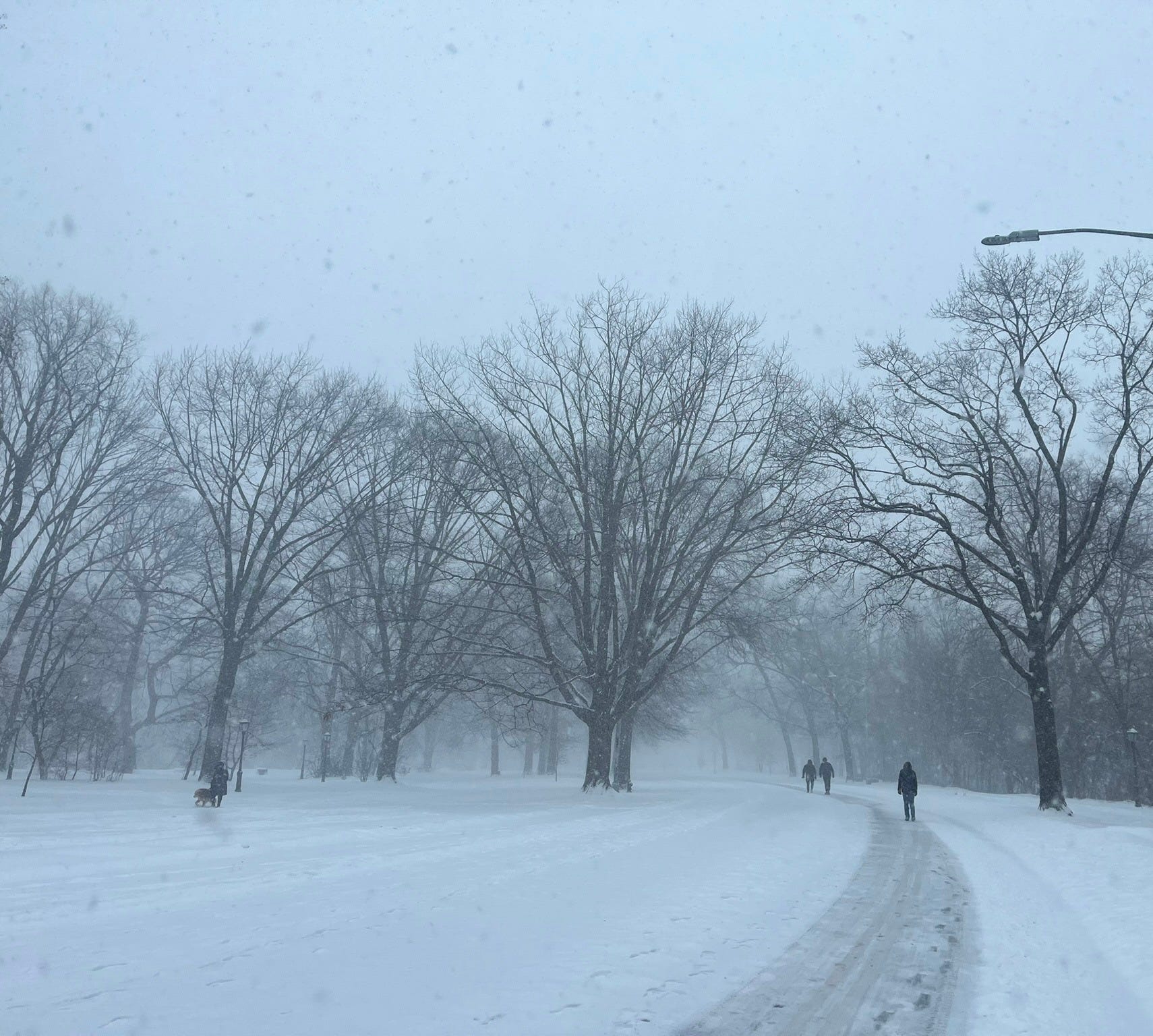
and so, in the mornings, i enter my desecrated sanctuary, its mess of dismantled shelves and shuffled books, splashes of sunlit dust winking, belying the polar freeze outside. i tuck into my corner and sit, eyes closed in quiet air. here, i thrum and know the future is an ancestor, that i belong to it and will arrive there, sooner than i know. how do i prepare? i ask the silence, who do i need to become? i feel the gradually-growing pressure of my life, the shudder of a creature at rest as it readies itself to move.
and i hear the cry called history, inaudible and echoing, a ricochet of souls.
. . .
. . .
of course, like everyone, i have been watching the ongoing horror and heroism of the Minnesota Intifada. in my slice of the infosphere, stories and feeds surging with fury and alarm and concern and paradox. the winter and bitter of it all. making stark, more stark, Where and When we are. the grotesque, hollow bravado of masked thugs flung against the genius and courage of civilians. the obscene violence of a (decrepit) superpower wielded against nurses and five-year-olds.
(remember, see? how power inverts and massacres the truth. how it will recognize no one, not even babies, as innocent. we have history, corpse children by the millions, already, to teach us this. when will we—we must—bury any remaining myth of respectability, of perfect victimhood, as anything but a softer noose)
of course i have staggered, strained in the relentless duality of living the personal and global each day, sometimes in the same moment, history hologramming into my living room, my kitchen, my bed.
and i have been reticent to add my voice to the thick chorus of commentary. after a long two years of speaking loudly and often, i have spent the last few months in relative silence and reflection. wary of the ubiquitous modern reflex—ingrained in large part by the culture of companies which stoke and profit from our animosity and outrage—to rush into declaring, opining in whittled soundbytes and memes.
of course, as a Palestinian, i feel a profound sense of recognition, resonance, remembrance as i watch this domestic occupation ramping up. recalling, of course, that for Indigenous folks the war has never ended, that racialized bodies (Black and otherwise) have been hunted here since this colony began. that what we think we are watching “unfold” has always been visible, palpable to some.
and that’s where we lose so much clarity, think. forgetting: time is a lie too. emergency dilates, swarms, overwhelms all, and this is an easy and effective tool of power. but we are not alone in this moment, not separate from the past as many of us, in the west, have been taught to think. neither are we free of the yet-to-come. we are inside the future, now, making it with every choice we take and every kindness we withhold. and i don’t mean this as the obvious “there’s historical context/precedent. . .”
i mean this has every implication. souls in all directions—i feel it. they ask something of us, mean something for us personally—the mothers we lost yesterday, and the tyrants who killed them centuries ago.
and then there are those some would call “descendants,” those we dream of as children, and their children and children and more. i call them ancestors of another sort (if this sounds crazy, i ask you: isn’t the person you are today both a stranger and deeply familiar to who you were ten years ago? if you listen closely, don’t you hear them whispering to one another—and to a you you don’t yet see?)
souls in all directions. we, webbed in them, webbed in their witness and legacy. in the wisest people i have read or sat with, i sense this is what they see. visionary—not anatomical sight, but an expansiveness that is also a surrender. a release of the bounded story of here and now.
why would we forfeit so much imagination, so much wisdom, so much strength? don’t you want to lose the myth of your singularity? isn’t it too much to bear, and impossible to understand, alone?
. . .
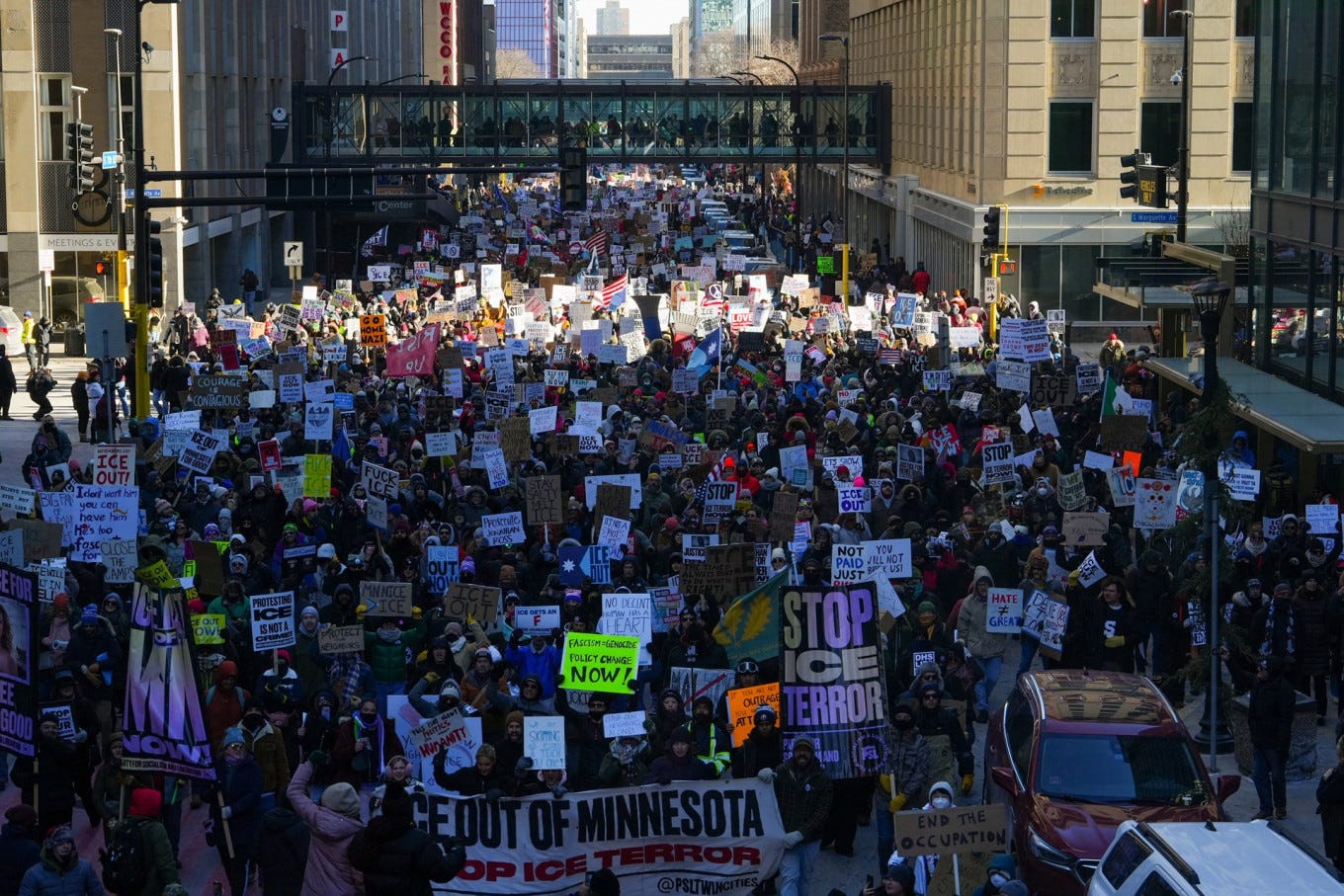
recently, i watched this conversation between several Indigenous activist/organizer/scholar/friends as they reflected on their recent experiences in Mni Sóta Makoce/the Twin Cities. theirs, adding to the compiling reminders that heart-work, and heartbreak, is integral to resisting and surviving the deep crisis of the hour.
a few lines i’ll plant here with a few fragments of my own contextualization, but i hope you’ll listen to this talk or any number of other local voices like theirs (follow Nick Estes and the Red Nation if you don’t), whose teachings are wise for Anywhere:
Your tears are the ancestors speaking [said an elder to a younger Indigenous man as he wept, feeling temporarily frozen by, the death of Alex Peretti—who the community sent off in sacred ceremony, recognizing this white man as, in some ways and because of his love, as belonging to, with, them]
We are moving with our hearts [not ideology or partisanship; hearts, which in moments of clarity access a wisdom that supersedes even what we can articulate. this, he says, is the wellspring of the endurance and courage the Twin Cities and their people are showing all of us]
They can’t attack where we are coming from [the “why” of why we move and resist] because we are coming from the right place . . .
. . .so they attack our relationality [our bonds of love and commitment and responsibility]
i am exhausted, but not tired.
. . .
no, the streets of the Twin Cities have not frozen, not even in bone-chilling cold. here, again, we are taught how a city can be a breathing, warm-veined thing. in footage, look closely and i’m sure you’d see Alex Peretti and Renee Nicole Good but also George Floyd and Philando Castille and an untold host of others—Indigenous, Somali, Mexican, Laotian/Hmong, and and and—moving alongside.
zoom out, zoom in. and see—this is our only hope.
. . .
in crisis, the temptation can be to move with the impetuousness of panic or grief, or to be stopped dead in ones tracks by what seem like impossible odds.
what to say about the failures, the defeats, the magnitude of our enemies? so much, and god help us if we don’t sit long hours next to the ruins, weeping and hearing, honoring and being marked by our dead and debris. we must not deny that, even in this one blink called a “lifetime,” each of us has seen immeasurable loss, unspeakable cruelty.
and it gallops on.
but god help us if we don’t learn from our failures, too. perhaps it is inevitable we will fail again and again. but we must fail differently. so much time and blood and money is wasted on repeating mistakes—perhaps none more costly or dangerous than the misunderstanding that our neighbor’s emergency is not our own.
may i repeat the obvious: we must hear the cry of Minneapolis as it joins the chorus of Sudan and Palestine, Venezuela and Iran, Congo and Haiti, and and and. how they all announce: our bodies already touch. how our timelines do not lay like straight tracks but braid, the today of one place the tomorrow of another, and someone’s yesterday.
i wrote about some of this recently. how Israel’s genocide in Gaza, and our failures to stop our own governments and dollars from their active participation in this slaughter, both foretold and formed the violent moment we see today. in this essay, i reflect on the lie of “afterness” and separation between “there” and “here.” i invoked Grace Lee Boggs and Ghassan Kanafani and my cousins, all of whom tell us this in their way, and i call to my own, tired body—in lament, in learning—to deeper love and responsibility.
i offer the link here, should you choose to read and share.
I am reading your work like the brilliance of our age. You have helped me to an understanding that I have been trying to reach burden apparently could not reach by myself. Your presentations of ancestors, time, our 10-year-ago selves makes so much sense in this time of chaos. The expanse you offer and the myopic view as well helps me to truly see! Thanks so much for such a beautiful and learned piece of writing!
The way this connects personal reconstruction with collective resistance is really poweful. The idea that time isnt linear and that ancestors exist in both directions completely reframes how we understand responsibility and solidarity. When I've felt paralyzed by the scale of crisis, remembering that my actions are woven into a larger web of witness has helped me keep moving. The Minnesota protests as part of a continuum ratherthan an isolated event makes so much sense.